
1. The beginning N Italy, toward the end of the sixties, the success of a singer or a vocal-instrumental group was almost always associated with songs of evasion. The bands, of various number of members, had two fundamental characteristics: a handsome singer, offering the looks for the female audience, and songs that are easy on the ear. The songs were mostly cover of english or american hits with italian lyrics that are far from the original context,
and finally with the advent of Battisti their choice was made for more creativity of the entire production. In this panorama I Quelli, group formed by Flavio Premoli on organ, Franco Mussida on guitar, Giorgio Piazza on bass and me on drums represented an exception. N Italy, toward the end of the sixties, the success of a singer or a vocal-instrumental group was almost always associated with songs of evasion. The bands, of various number of members, had two fundamental characteristics: a handsome singer, offering the looks for the female audience, and songs that are easy on the ear. The songs were mostly cover of english or american hits with italian lyrics that are far from the original context,
and finally with the advent of Battisti their choice was made for more creativity of the entire production. In this panorama I Quelli, group formed by Flavio Premoli on organ, Franco Mussida on guitar, Giorgio Piazza on bass and me on drums represented an exception.
This new fermentation, together with a great will for discographic redemption, rushed for new identity, with sound out of a very experimental scheme which we called "Chitabasbatorga" (guitar, bass, drums and organ). And things started to move on. During an evening at "Paradiso", a club near Brescia, a friend told me about a musician who was playing the flute and the violin with an air more of rock than classical. It wasn't difficult for me to trace Mauro Pagani to arrange a meeting. The phone conversation went like this: We continued to perform at dancehalls, but there was increasing sentiment among us for the needs of changing the repertoire and the musical genre, as well as the needs to integrate Mauro in our formation. The music of the group started to change slowly. The tunes became harder and harder to dance to, since the solo parts were extending more and more. We felt the needs for new stimulation, new models. They were found in "Chicago", "King Crimson", "Jethro Tull", "Ekseption", and "Flock", the groups whose conventional structure of songs were broadened awarding more room for arrangement, virtuosity, and improvisation. We started to experiment in very hard laboring pitch, almost military. With the sessions lasting 8 hours and salty fine for lateness, which was used to finance new instruments and a car to tour together, the metamorphosis began. For survival we continued our activities as session-men and even between a record by Battisti and one by De Andre, I was on loan to "Equipe 84", a group for which I already had recorded with, for their single "Tutta La Mia Citta". In fact, unusual for the epoc, it was 1970, in the revival of "Equipe 84", the band (and I) were competing in the San Remo festival coupled with Lucio Dalla. "Equipe 84" had been needing regular drummer for 8 months, while "I Quelli" needed to change the record company. At that moment the two groups were signed to the same label, Ricordi, and there wes a fair chance to ask for the cortesy appearances. In this manner I Quelli succeeded to liberate themselves from old contract: we left Ricordi and followed other dissidents; among them were Lucio Battisti, Alessandro Colombini and Mogol, who were in open opposition with the milanese company, were in preparation for a new record label, Numero Uno. The opportunity to debut in the progressive version was just there at the San Remo festival of that year. We signed up with "Whiskey Club", an adjacent club to "Teatro Ariston", to perform as an alternative attraction in the city flooded with pop songs. "Nothing commercial" was the request, "but only the transgressive energy of pop music". In this state of playing an away-game, my role as a musician on loan assumed really curious aspects. From 8:00pm to 11:00pm, all dressed up, I'd show up educatedly on live TV broadcast from the box salon of casino parties, later join the friends at the club, change to musician's kind of dress and turn myself into a sweaty rythm machine. Our repertoire was perfected, arranged to the state of art to capture attention of listners and consisted primarily of tunes that are particularly difficult by the most avant-garde bands of the time. The audience, packed in the small club every evening to see the band do "Turkish stuff", as they used to say then, confirmed that it was the right way for us to go. After the phase of San Remo and signing contract with "Numero Uno", moment has come to think about changing the band's name. We wanted a definite separation from the past, although we were well-known, in the way that we'd lose all the grounds as "I Quelli". The new name should be diverse from what's been heard of, like for example those usual names of animals which were in such vogue in the 70's. It was not an easy task, and an entire afternoon of imagining hypothesises, the choises narrowed down to two: "Isotta Fraschini" and "Forneria Marconi". The first was a famous automotive brand, and the second comes from the sign of a bakery shop in Chiari, a small town in the province of Brescia. The record company objected: "It sounds more like a factory name than a musical group." The idea of prestigeous factory seemed like a good auspice for someonelike us who were so accustomed to "fabricate" sound for for others. Finally the choice was made on "Forneria Marconi", but yet lacking somethig, as Alessandro Colombini made suggestion, so the title "Premiata" was added, a reminder of the long path through the ranks, and in the meantime a little autogratification to certify the quality of the company. At "Numero Uno" there was someone objecting that "Premiata Forneria Marconi" was too long a name, but the group's philosophy was clear: the more difficult to remember the band's name, the more difficult to forget it. It was the best line, and the very original choice proved to be correct so much to infect the whole Italy in the 70's. In short, at that point all the ingredients were there: the desire, the grit, the tight-rope repertoire, and a name too. All we needed was a good chance to let us known to the public. Franco Mamone, the manager of "I Quelli", knew intuitively, together with Franco Sanavino, the end of the dance hall days. The managers of a province turned themselves into the promoters of the intenational group, the most important of the moment. Mamone proposed to be the manager for PFM in exchange for our performance as the support act for the concerts he would organize. We started with "Procol Harum", and finally "Yes", landing right after the event of the season: it was about doing the support for "Deep Purple", the biggest name in rock back then. The idea was a bit risky, but the courage and a fine dose of nerve we always had in us. The first evening of the concert which took place in Bologna, nobody would have bet those five crazy guys would open up for the "Purple". The audience, waiting for Ian Gillan and the company, was well excited and turbulent that the organizer did not dare to present us, because the italian name was so long and absurd. So we started out of the darkness and among the audience's surprise we began playing "The 21st Century Schizoid Man" by "King Crimson", the opening piece of our repertoire. After several minutes of astonishment in which the arena seemed like a silent sea of worried heads, the audience was captured by the ability to perform and by the impudent decision we exhibited up on the stage. Everything spun smoothly and we finished the concert in applause. They were much in wonder who that "English band" was, who opened the concert. "This is Premiata Forneria Marconi", said Sanavino, feeling relieved at the end of the performance, "they are Italian and they will be talked about". The tam tam of the rocking crowd made its sound and the echo of the beautiful evening carried afar.
2. From Europe to America HE recording of Storia di un Minuto followed after the small hit of our first 45rpm single (Impressio
ni di Settembre b/w La Carrozza di Hans). The production of the LP was the fruit of precise selection: performing totally live to imprint the marks of energy and spontaneity onto the disc. And in fact "Storia di un Minuto" bursted out magic that it was welcomed and appreciated by the public to the point that the disc was brought up to the top of the chart (it was unprecedented for an LP by Italian group).Mussida wrote the music, Pagani did the lyrics and we all together arranged the album under the supervision of Claudio Fabi, who in the meantime substituted Alessandro Colombini as the artistic director of Numero Uno. HE recording of Storia di un Minuto followed after the small hit of our first 45rpm single (Impressio
ni di Settembre b/w La Carrozza di Hans). The production of the LP was the fruit of precise selection: performing totally live to imprint the marks of energy and spontaneity onto the disc. And in fact "Storia di un Minuto" bursted out magic that it was welcomed and appreciated by the public to the point that the disc was brought up to the top of the chart (it was unprecedented for an LP by Italian group).Mussida wrote the music, Pagani did the lyrics and we all together arranged the album under the supervision of Claudio Fabi, who in the meantime substituted Alessandro Colombini as the artistic director of Numero Uno."La Carozza di Hans" still presented a Crimson-ish atomosphere, but other songs had very innovative sounds. "Dove ...Quando...", with 15th century atomosphere in the first part, and jazzy second, togeher with "Grazzie Davvero", a piece with mastery wind orchestration elaborated by Premoli, are two of the most successful musical moments. "Impressioni di Settembre" is presented in a spacious version, which amplifies the emotional impact of the frase on Moog, an instrument typical and perhaps emblematic of the musical sensibility of the 70's. "E'Festa", a piece which was performed to the world more than any others, is the first Tarantella rock which evidently marked the recuperation of the idioms of our popular music. Mixed in the electronic sound of the synthesizers, the Mandolin and other instruments, that are unusual for rock, found themselves the sound that is uniquely Italian and finally capable of competing with those of great foreign groups. It was a proper thing to do in this perspective, on the wave of big enthusiasm by the first disc's hit, that we went back to he recording studio for the second LP. Our intention was to attempt a great jump toward Europe. There wasn't a presumption to believe in the possibility, but we had the consciousness that, apart from the language, we were an international material. Besides, the major managers who accompanied the foreign groups in Italy had the same opinion also, and encouraged us to take a big step.
The second LP, Per un Amico was well received by the public, but a little half-heartedly by the critics, for the epoc definitely inclined toward foreign groups. The album was made deliberately diverse from the first one because in principal we did not want to clone the success of the precedent.
The first change in the formation of PFM took place in the recording of the third album. The needs for obtaining evermore personal and effective sound pushed the group toward serching for a musician with gifted vocals. Following evaluation of various hypothesis, upon suggestion of Pete Sinfield, even the candidacy of John Wetton, fine bassist-vocalist of native (english) language, there was an encounter which gave the group another turn in the summer of 73.
Franz Di Cioccio
(English translation by Tatsurou Ueda) ...to be continued |
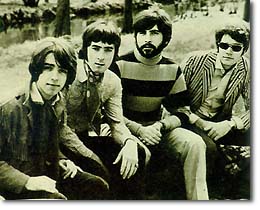 In fact we were each singing a little in turn, but our obsession was the attention we confronted with the musical parts and their execution in live. Discovered and utilized
for this gift by the prominent arrangers of the time, such as Reverberi, Massara and Mariano, we started to frequent more and more to recording rooms, collaborating with important artists such as (Lucio) Battisti, Mina, Celentano and (Fabrizio) De André. We were even called in to record base music for other successful bands like "Equipe 84", "Dik Dik", and "Camaleonti". The records of I Quelli had a discrete hit, however this was not what we were talked about in the musical society, but in fact, we were regarded as the quartet most quoted and requested in the circle of session men. We were fortunate that we had somewhat rare case of artistic longivity like "Nomadi" or "Pooh", coinciding with the unarrestable ascent of progressive music. In this vein, the term pop music could be labeled as merging fragments of classical music, jazz, popular music and rock. It was a fine melting pot of ideas which gave vent to more total creativity. We felt we were were destined,in that moment, that we werre meant to be more than a simple accompanying musicians, but to represent heartful communication of youngmen spoken in the language of instruments.
In fact we were each singing a little in turn, but our obsession was the attention we confronted with the musical parts and their execution in live. Discovered and utilized
for this gift by the prominent arrangers of the time, such as Reverberi, Massara and Mariano, we started to frequent more and more to recording rooms, collaborating with important artists such as (Lucio) Battisti, Mina, Celentano and (Fabrizio) De André. We were even called in to record base music for other successful bands like "Equipe 84", "Dik Dik", and "Camaleonti". The records of I Quelli had a discrete hit, however this was not what we were talked about in the musical society, but in fact, we were regarded as the quartet most quoted and requested in the circle of session men. We were fortunate that we had somewhat rare case of artistic longivity like "Nomadi" or "Pooh", coinciding with the unarrestable ascent of progressive music. In this vein, the term pop music could be labeled as merging fragments of classical music, jazz, popular music and rock. It was a fine melting pot of ideas which gave vent to more total creativity. We felt we were were destined,in that moment, that we werre meant to be more than a simple accompanying musicians, but to represent heartful communication of youngmen spoken in the language of instruments.
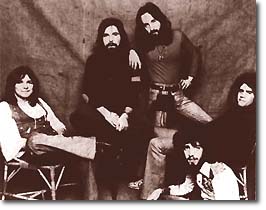 The time was indeed changing and everywhere they'd organize or think about a pop festival It was really in one of these gatherings where one would be given a great occasion to grow artistically. It was in the summer of 1971 in the pine woods of Viareggio, when the first "Festival of Avant-Garde and New Movement" was held. It was the most important pop gathering of the year and there we witnessed the new music of Italia to emerge in reality. The event called for an unpublished tune, and Franco Mussida, the writer of songs in the days of "I Quelli", had a tune composed in his mind, in the van from Milano to Torino; "La Carrozza di Hans". The next day the tune was arranged and at Viareggio the "Premiata"(prize-winner) surprised all with a memorable performance. Led by the electric introduction and overwhelm, among the astonishment of all, Mussida carried onto the classical guitar part and, with the sweet arpeggio, he led the audience fly into the fable of Hans, the merchant of dreams. It was a triumph, and "PFM" won the festival prize along with "Mia Martini" and "Osanna".
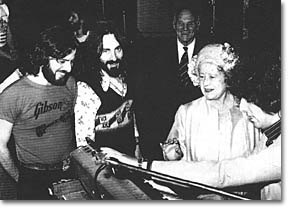 His participation was right at the time of the recording of the third LP