

|
BOOTLEGS, Sound Quality of - 1. Bobo Club 2000 - 1972: Its recording quality is not good, mono audience recording. The performance by original lineup is strictly based on the arrangement in their first album; however, some improvisation numbers are played. Especially, Mussida's acoustic guitar is not featured very often, so "Dove,,, Quando..." is backed by his electric guitar. In improvisation part, similar phrase in later "Alta Loma Five Till Nine" will be heard. 2. Four Holes in the Chocolate: This bootleg's recording quality is not good, either; furthermore, unfortunately, the recording source would be two (or more), and both of them were to be recorded by an audience (surely, mono). So, in some numbers, the difference in the pitch of tape recorders could be minded. "Four Holes In The Ground" recorded at two different places and one hyper technical number from Chocolate Kings are included. Their performance sounds a bit wilder than Live In USA.
3. Blowing From The Mediterranean: This bootleg was recorded in Paris, 1975, and it's recording quality is excellent. This bootleg might be recorded around PA set (surely, stereo). A crew's or audience's (the same person's) handclap would be minded sometimes. The arrangement is much the same as in "Live in USA" and BBC London 1975 (see below)." They play numbers from their first three albums. In addition, for MC, they speak French.  4. London 1975: As other BBC live albums (I have a Tempest's bootleg, too), the sound quality is super. CD of this live is recorded from the LP, and trucking error is found in "Alta Loma Five Till Nine." MC to the audience (radio listeners might be included) is long but quite kind introduction of PFM itself and each number they play. The arrangement of "Alta Loma Five Till Nine" is completely different, solid, and
simplified.
4. London 1975: As other BBC live albums (I have a Tempest's bootleg, too), the sound quality is super. CD of this live is recorded from the LP, and trucking error is found in "Alta Loma Five Till Nine." MC to the audience (radio listeners might be included) is long but quite kind introduction of PFM itself and each number they play. The arrangement of "Alta Loma Five Till Nine" is completely different, solid, and
simplified.Among the above bootlegs, I recommend "Bobo" and "Chocolate" since both of them represent PFM's wild side. "London" and "Blowing" sound a bit cool (not so exciting) to me. The reason would be that the former two bootlegs were recorded in Italy. I prefer listening to "Four Holes In The Ground" and "Alta Loma Nine Till Five" in different arrangement. Pagani's flutes and violin play in these numbers is the key. For PFM live recordings for official and bootleg albums, I suspect that PA would be one cause to lower their quality. Mussida's guitar, Pagani's flutes and violin, Djivas's (or Piazza's) bass, Cioccio's drums are OK, but Premoli's keyboards are recorded in each album just like "Oh, he is playing somewhere in the deep hole, isn't it?" Especially, the sound of mellotron and Hammond is quite poor. [H. Nagano] |

|
|
DE ANDRÉ, Fabrizio (pron. day-an-DRAY) - Italian songwriter and singer, born in Genova in February, the 18th 1940 . He was one of the leaders of the motley "revolution" in singing style in Italy in the 60s, that abandoned the old-fashioned ties to the "bel canto" in favour of a more modern style, partly inspired to French musicians such as Brel and Brassens. They were dubbed the "cantautori", a blend of the words "cantanti" (singers) and "autori" (songwriters). Other notable cantautori were Gino Paoli, Luigi Tenco, Giorgio Gaber and several others. De Andre's production is impressive, ranging from ballads such as "La canzone di Marinella", possibly his best known composition, to concept albums like "Storia di un impiegato", inspired by the events in the French May of 1968, or "Non al denaro, non all'amore ne' al cielo", with eight ballads extracted from Edgar Lee Masters's "Spoon River Anthology". During the Seventies he toured with PFM, the event being testified by the release of a live album ("In Concerto") where the chansonnier and the prog rock band play together in a most effective mixture of styles. De Andre' was the target, together with his wife Dori Ghezzi, of a kidnap for ransom by a Sardinian gang. The couple were released after some time and eventually Fabrizio recorded an album (Hotel Supramont) inspired by the traumatic event. [S. Toria] |

|
| KREL, I - See Quelli, I |

|
|
ORIGIN of Name, the - "Premiata Forneria Marconi" translates into "Prize-winning Marconi Bakery". It was common, back at the beginning of the century, to confer awards to commercial establishments for their outstanding achievements. Quite often these awards were mere titles of honour, useless labels of the I-got-it-so-I-must-be-better-than-you type. Anyway, the establishment would then be acknowledged the right to insert the word "Premiato" or "Premiata" in its trade mark. "Forneria" is a slightly old-fashioned word; we would just say "Forno" to-day (lit. "Oven"). "Marconi" is just a family name. Therefore to an Italian the name "Premiata Forneria Marconi" would have a distinctly "Ye Olde Times" feeling. [S. Toria] |

|
| PFM - The band changed the name from "Premiata Forneria Marconi" to "PFM" after they released "Photos of Ghosts" from Manticore. According to Di Cioccio, they started to use "PFM," since nobody could precisely pronounce "Premiata Forneria Marconi" during the tour in foreign countries. And they were also tired to answer the question, "What the abbreviation "PFM" means?" But they continued to use the original long name and were introduced by it afterwards. [H. Nagano] |

|
|
QUELLI - Krel and Quelli are actually the same. They used the two different names just before they played for a Lucio Battisti's album, when they were searching for their musical orientation toward progressive rock. 1.Original Lineup of Quelli: Franz Di Cioccio (drums), Pino Favaloro (guitar), Tony Jesardi (bass), Augusto Lo Basso (left soon), Franco Mussida (guitar). 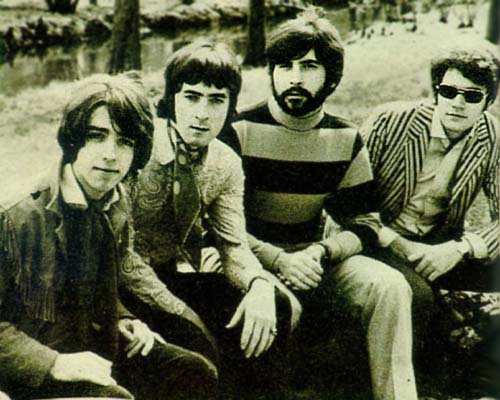 Then Mussida was a temporary member joining the band after 1800 hours.
2. Lineup when Debut Single: Franz Di Cioccio (drums), Pino Favaloro (guitar), Tony Jesardi (bass), Augusto Lo Basso (left Soon), Franco Mussida (guitar), Flavio Premoli (keyboard; from a band named "Chuccioli"), Teo Teocoli (vocal). Teocoli was a comedian, and the band was named Teo & I Quelli then. They used to play with "Bugs Glow," which became "Area" later. For Bugs Glow, Demetrio Stratos and Giorgio Piazza was playing. 3. Member changes after the Debut Single. When  Jesardi left for joining the army, he was replaced for Piazza. Teocoli
took off for a solo singer. Favaloro and Mussida also left the band, and Alberto Radius substituted for Mussida till he came back from the army. Before joining Quelli, Radius used to play for "Big Bens" and "Simon & Penny." Later, Mussida came back, so Radius left the band.
Jesardi left for joining the army, he was replaced for Piazza. Teocoli
took off for a solo singer. Favaloro and Mussida also left the band, and Alberto Radius substituted for Mussida till he came back from the army. Before joining Quelli, Radius used to play for "Big Bens" and "Simon & Penny." Later, Mussida came back, so Radius left the band.4. Final Lineup: Franz Di Cioccio (drums), Pino Favaloro (guitar), Franco Mussida (guitar), Flavio Premoli (keyboard). Mauro Pagani (flutes, violin) joined from "Dalton," and then Premiata Forneria Marconi started its career. Then Pagani was regarded as the leader of the band. [H. Nagano]
Una Bambolina Che Fa No No No / Non Ci Sarò Single - Ricordi, SRL 10.443 (Italy, 66) Per Vivere Insieme/La Ragazza Ta-Ta-Ta Single - Ricordi, SRL 10.459 (Italy, 67) Tornare Bambino / Questa Città Senza Te Single - Ricordi, SRL 10.479 (Italy, 67) Mi Sentivo Strano / Dettato al Capello Single - Ricordi, SRL 10.502 (Italy, 68) Lacrime e Pioggia / Nuvole Gialle Single - Ricordi, SRL 10.525 (Italy, 68) Dici / Marilù Single - Ricordi, SRL 10.544 (Italy, 69) Quelli LP - Ricordi, SMRP 9053 (Italy, 69) Dietro al Sole / Quattro Pazzi Single - Ricordi, SRL 10.590 (Italy, 70) |

|
|
SINFIELD, Pete - Sinfield was a major "behind the scenes" force in progressive rock music. A lyricist, songwriter, and musical director, he also produced albums for Esperanto and Roxy Music. He worked with his old friend Greg Lake in shaping several Emerson, Lake & Palmer albums, both as co-producer and contributing writer. He helped shape the future of Premiata Forneria Marconi by writing their English lyrics, and then teaching the band to sing them by rote. He also remixed PFM's Photos of Ghosts, showing the band how some minor changes could improve their sound. And, of course, he was heavily involved in the original King Crimson as roady, lightman, lyricist, producer, and group "co-owner" until "musical differences" caused him to depart. Pete Sinfield's own solo album Still, released in 1973, was a remarkable piece of work. It incorporated melodic themes in jazz and rock settings. Progressive by intention, the album pre-dates the New Age sound which became popular in the early 1980's, and which continues to flourish to this day. The album was sophisticated in both musical and lyrical arrangements. Although many famous musicians played and contributed to the album, Sinfield kept a tight rein on the  production. This control resulted in subdued and refined performances. Unfortunately, Sinfield only recorded two additional songs before abandoning his recording career for full time ELP producer. These two songs are finally available as additional tracks on the CD version of Still, which was re-named Stillusion by Sinfield upon it's release in 1993.
Sinfield's contribution to PFM's Photos of Ghosts was remarkable in that a few alterations changed the entire complexion of the album. Sinfield eliminated the introduction to "River of Life," thus starting the composition right on the main theme. He added the Freeman Symphonizer to the mix, which gave clarity to the string sound already produced by the mellotron. The explosion at the song's finale brings resolution in a manner only suggested by the original. By the time PFM recorded their next album, the song arrangements were more concise and their playing technically confident. Sinfield again wrote English lyrics for The World Became the World and changed the vocal line on "The Mountain", making it more anguished in tone. The group's rising success in English markets, thanks to Sinfield's direction, led to their hiring an English speaking lead vocalist, and full English recording for the next studio album Chocolate Kings. Sinfield's poems show his penchant for the ponderous and overblown ("In the Wake of Poseidon" and "Prince Rupert Awakes") and death ("Epitaph" and "The Letters") along with sexual humor ("Ladies of the Road" and "Topper Tackett"). Much of Sinfield's whimsy and fantasy, once accused of being psychedelic in nature, and therefore disposable, is still charming in this writer's opinion. But the best are those poems, such as Photos of Ghosts and "Raindrops" which reveal an aching poignancy. They are still capable of creating a mood, even after years of reading. Try and find a copy of Sinfield's book Under the Sky. First published in 1974, it is beautifully laid out, and complete with drawings. Pete Sinfield was an artist in all senses, contributing music, poetry, and artistic direction to all projects in which he became involved. His sense of quality and taste continues to amaze younger admirers today, and serves as a model for humanistic involvement. [David Eric Shur] |