 ARLY ENGLISH music? Gah - give us Slade and T. Rex! Thus one can imagine the reactions of lads and maidens today as they dance, somewhat drugged around ye village discotheque.
Not for them the stilted, febrile music of the worthy country dancing club, or medieval madrigal society. They want raucous excitement, and they are making a big mistake.
Years of Morris dancing and flitting around Maypoles have left an impression upon the public consciousness of the music of earlier times as being little more than a fey fol de rol.
Fools! They may not have possessed the power of 2,000 watt PA systems in Shakespearian times, but they knew how to get high on music. They had hot bands in those days that could jam for hours until players and dancers fell exhausted.
 The aforementioned public smugly imagine that 20th century pop has a monopoly on excitement. But four hundred years before the birth of rock and roll, king and peasant alike raved to a brand of music that makes mock of our much vaunted heavy groups.
I know - I have heard that music, today! Or rather last Thursday to be precise, amidst the hallowed and normally hushed portals of the Victoria and Albert Museum, London, England. And a few days before that, within tipping distance of the Grand Union Canal.
But I speak in riddles. Let all men know that I speak of GRYPHON and none other.
Last week was rather special in the brief career of the nation's most charming new group. For Gryphon experienced fan-mania. They were mobbed by laughing, smiling wenches of some 14 summers, waving autographs books. They were chased around the silver collection in the Victoria and Albert, photographed and blazoned from the pages of such esteemed journals as The Guardian and the Radio Times.
In the meantime they carried their own crum-horns, and humped their own harpsichords, happy, bemused and well aware of the massive debts banging over them. Even a band that eschews electric guitars and synthesisers for bassoons and recorders is up against the harsh realities of the rock environment.
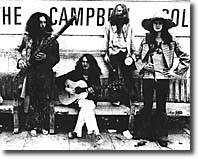
But who are Gryphon, and what were they doing at Vic and Bert Museum? They are four cheery and talkative fellows, whose brightness and intelligence gleams in contrast to the dull ignorance of the scurvy knaves one is accustomed to encountering on one's daily round.
Two of them are graduates from the Royal College of Music, and were set for careers in classical music. Their drummer is a man who has experienced the rough and tumble of a hard core rock band. Their musical prowess is exceptional. They are gifted with humour and above all they have a charisma that will ensure them a measure of success they at present view with guarded optimism.
Attired in fineries that blend Court Jester with Kings Road, they make an impact on stage that has been described as 13th century Slade.
Most powerful personality is arguably Brian Gulland, a virtuoso on the bassoon, and an expert on the crum-horn, a reed instrument of German origin, "crum" meaning "bent" hence, a bent horn. Brian plays these difficult instruments with great wit and invention. A mass of hair falls to his shoulders, and in a coat half red and half yellow, he resembles a jester secretly engaged on alchemy fearing the King's spies. He has a bass voice, capable of shivering timbers. Graeme Taylor their acoustic guitarist. in contrast, is quiet, gentle and on being confronted with a goose, would probably have great difficulty in uttering "boo". He also forms one third of the Gryphon recorder "choir" when featured.
Richard Harvey is freely described by his cohorts (in his absence) as a genius. He is certainly a fine musician, who could have pursued a career as a clarinettist with one of the country's best symphony orchestras, if he had not chosen a life in pop. Now he plays the crum-horn, keyboards, mandolin and recorders, giving the latter an unexpected scope.
On drums is David Oberle, who has brilliantly adapted his rock schooling to the peculiar demands of early music, tuning a reduced range of drums, to suit medieval requirements, without losing power and drive.
MY first brush with this bizarre ensemble came at Dingwall's Club, near Camden Lock one of the new breed of London music workshops, where the accent is less on volume and more on music. They were playing to a sparse crowd, who knew them not. But within minutes of unleashing such pieces as " Sir Gavin Grimbold" and "The Devil And The Farmers' Wife", there was an outbreak of jigging and hollering of a kind not heard in London since off-street bear baiting was suppressed by the City Fathers.
Their music ranges over the centuries, including adaptations of familiar folk songs, original compositions, Beatles tunes, Elizabethan jigs, and 13th century English dances like the "Estampie" which has more rhythmic excitement than a rock 'n' roll convention.
Down at Dingwall's as the lightning dexterity of Richard's soprano recorder trilled over Dave's inexorable drum beats, played at a furious tempo, so the soles of my feet began to itch. Casting lager to the winds I was forced into a dancing position, and for minutes on end jigged and danced, gasping and panting, temples swelling, eyes bulging, all the while uttering half-human cries.
As Brian's bass crumhorn honked a sonorous solo of almost mystical power my knees gave way, until your correspondent sank to the floor, mouth flecked with foam. Bright specks of light swam before my eyes, and bells chimed in my head. It was an exhausting, stunning experience. And I determined to follow this group further.
Even in these gross and gaudy times, skill and orig-inality will out and it is pleasant to note that Gryphon are much in demand. They have recorded film music, including the title track for the rock movie "Glastonbury Fayre." They have been in incessant demand for radio, and actually appeared on seven separate programmes last week, on all the BBC's national net works.
They have been requested to play at Cathedrals (St. Paul's and Southwark), at universities, and prisons. At Wandsworth they were received with raspberries of a kind that would have brought tears of recognition to Wm. Shakespeare himself.
Crumhorns are expensive items, and the band are still going out for low money which barely covers their costs. They have one roadie, the over-worked Nick Glennie-Smith, and have been renting a van. They are still playing gigs free, including the combined lecture and concert they gave at the Victoria and Albert for school children.
It was in many ways a comic afternoon. Gryphon had imagined the audience would consist of youngsters from about l4-l8. Instead, there were many babes in arms who responded to jigs with appreciative gurgles, and the eldest were the schoolgirls who sat in the museum's lecture hall, enraptured.
The concert was a huge success. The sound of cheering and demands for an encore stunned attendents, browsers, tourists and staff. One got the feeling nothing so exciting had happened there since enemy action between the years. 1939-45.
The group played their favourite pieces like " Sir Gavin Grimbold," and behind them were projected slides depicting musicians and characters from the appropriate periods. They played a fantastic version of Paul McCartney's "Mother Natures Son", and "Estampie," gathered speed like an express locomotive, on which the bassoon improvisation somehow managed to take in "Over The Rainbow", and "Chattanooga Choo Choo".
The art of recorder play-ing was brilliantly displayed on "Tea Wrecks", which featured Brian, Richard and Graeme, and after a medley of jigs, encored with the unlikely and perhaps unsuitable "Ain't She Sweet".
Mild pandemonium broke out after the concert and continued unabated for several hours afterwards. The group were pursued down stone steps by their young fans, and a hubbub ensued watched with considerable unease by the attendents.
GRYPHON'S music has that endearing blend of authenticity and exhuberance that makes it much in demand for period motion pictures, and Richard later revealed: "We have been doing a lot of sessions for two films 'Brother Son, Sister Moon', and 'Pope Joan'. The last one is about a woman who was made Pope in medieval times. I've played a lot myself for the BBC on things like the 'Merchant Of Venice,' and we nearly did the music for the film 'Sir Gawaine and the Green Knight,' but in the end they got Ron Goodwin to do it. We did a lot of sessions though and we got £250 each for that, which was a very big financial help".
"We only get about £46 for a gig' and we have a lot of expenses, like £20 for the van hire and £5 for the roadie, petrol and food. So we get about £6 clear from a £40 job. And we're still working off £20 jobs. We're trying to get Transatlantic to cover the losses on promotion. We're all heavily overdrawn, and we had to pay back the initial £1,000 it cost to launch the group out of our advance the record company. We've borrowed money from our parents, and now we are buying a van of our own.
"When we first started we had no name, and it took us four or five months to think of one. We did one gig as Spell Thorn, and our first manager wanted to call us Cod Piece, which was rejected out of hand.
"I was at school with Graeme and met Brian at the Royal College of Music. We met Dave through a friend. He had been in a rock band called Juggernaut, which folded.
"The concept of the band has changed quite a bit since it started, On our second LP we want to get more into production. We are all multi-instrumentalists and we want to use all the instrumental textures we can. To a certain extent we started as a serious early music band, But you can't help each member's musical influences shaping the band and they are certainly not suppressed
"We started off playing the folk clubs, and the re-action was fantastic. We had a support spot at a Wimbledon folk club and did "Sir Gavin Grimbold". The reaction took us all aback. We were worried about upsetting the folk traditionalists, but it didn't seem to matter.
"We had to work harder at colleges, and we were so unprofessional at first. People told us we had to get a stage act together. But it didn't take long once we started playing a lot. Last June we had 16 gigs and we feel at home on stage now. My total musical experience before Gryphon was purely at classical concerts, where you would rehearse in the morning from ten to 1 pm. In the evening you'd turn up for the concert in your evening dress.
"It was the dinner jacket syndrome that turned me away from classical music, and anyway, the bow-tie throttled me. I gave up the clarinet because there are more clarinettists than any other instrumentalist, and I thought there was no career for me as far as getting a job was concerned. Getting into an orchestra is practically impossible. In fact I had an offer to join the New Philharmonia, but I had already decided to give up classical music and go into pop.
"I used to be receptive to folk music, but I thought rock was a bit of a joke. I was completely out of touch with rock. Then one day I went round to Brian's flat and he put some headphones on me, and told me to listen. It was the first side of 'The Yes Album'. I heard Yes for the first time and no piece of music has ever had such a drastic effect on me. It changed my whole life. It was not only proved to me that pop musicians were capable of writing incredibly good music, but they had incredibly good technique as well. All my bad impressions were totally swept away. It was a real revelation."
GRYPHON are in that happy state when events are moving too fast for them to worry overmuch about the future. They are more concerned with the practicalities of running the band and improving its chances.
"We want to get the PA system modified to get a bigger sound and cut out feedback. And we'd like to use phasing, tape-echo and fuzz. We bought a harpsichord but it was hopeless on tour as it kept going out of tune. We'll get an electric piano that gives a harpsichord sound.
"In medieval and Renaissance times there was the same music that we have - classical and pop. Medieval pop was the same as it is today, except that it was governed by the instruments of the time. The players were fantastically good, and we know this because of the written music and the craftsmanship in making the instruments. Pieces of music like the "Estampie" were played for hours until they all fell over."
Toasts were drunk in wine to the future of Gryphon and the party split up in all directions leaving Dave and Brian gazing at the rice strewn table cloth. "Well I hope something happens for the band," said Dave sagely.
"I have the feeling it will," said Brian, adjusting the reed of his crumhorn. "It's kharma."
Chris Welch
(Melody Maker, August the 4th 1973)
|
