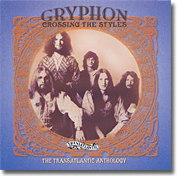
Booklet Notes
 URING the golden years of the early 1970s, there were so many bands pulling in different directions that the whole concept of 'progressive' music seemed to become very confusing. And yet, what held the genre together was a general strand running through all the bands of a respect for music. Each one might have had their own policy and approach, but they all fundamentally understood that what they were attempting to do was bring a sense of artistry to rock 'n' roll. And none, perhaps, was better at achieving this blend of traditional and modern than Gryphon. And none more prepared do go out on a limb.
Quintessentially English, they drew inspiration from a variety of sources, in particular the Medieval period. In fact, they can claim to be among the very few bands in rock history who actually had a royal songwriter on an album, with Henry The Eighth credited as writing the track Pastime With Good Company on their 1973, self-titled debut album.
The band formed in 1971 when Richard Harvey and Brian Gulland met while studying at the Royal College Of Music. They found common ground in a fascination with music that was slightly off the beaten path; Harvey had already served time with an ensemble called Musica Reservata, and was even proficient in the traditional English instrument the krumhorn, as well as the renaissance recorder. Gulland was intrigued by church music. They brought together their talents, and recruited Graeme Taylor, an old mate of Harvey's, on guitar. This trio started gigging, but not for them the bars, clubs and pubs which were the norm for most young bands - they played in reconstructed medieval eating establishments! Within a short time, the band completed their line-up with the arrival of drummer Dave Oberle..
By 1975, the band had strangely all but given upon their unique musical path. They seemed.to crave a more acceptable commercial acclaim, more in keeping with the prevailing prog rock winds the tie. "So, the remarkably challenging and formidably inventive music of what had gone before was toned down for Raindance, an
album which saw Gryphon going for more obvious song structures, relying less on the more eccentric arrangements and instrumentals that had flavoured their career until then, and giving greater significance to the more comfortable, electric musicianship of the rock era. Nonetheless, this seeming abandonment of older values didn't undermine Gryphon's sound as much as wasfeared. And the epic (Ein Klein) Heldenleben' remains one of the band's finest recordings..
However, a noticeable shift in the musical landscape had started to happen by the mid-70s. Punk was on the horizon, and genteel sounds evinced and represented by Gryphon, were about to swept away in a tidal wave of spittle. So, 1977's Treason. wasn't so much as a push onto new pastures as a case of digging a dignified grave. Harvey, Gulland and Oberlé (now on percussion and vocals) were joined here by drummer Alex Baird, bassist Jonathan Davie and guitarist Bob Foster, Oberle's Phil Collins-esque elevation from behind the kit to the front of the stage actually provides Treason with some unusualIy effective moments - and proof that Gryphon still had
much to offer. Unfortunately, the end was in sight - and Gryphon split-up soon after the release of Treason. Interestingly, Oberle was to appear on the debut album from Wire, 1977's Pink Flag. Produced by Alike Thorne, who also worked on Treason, this was something of a passing of the baton, because Wire may not have had much in common musically with Gryphon, but they had the same seemingly English sense of individuality and perspective.
Since then, Oberle has carved out a successful career for himself, firstly as part of the early history of Kerrang! magazine (he was advertising manager), and then running his own label, Communique. Harvey has been enormously successful as a composer and performer, working on film and TV soundtracks, as well as with Kate Bush, Gordon Giltrap, The Divinyls and Elvis Costello. Brian Gulland has subsequently worked with Richard & Linda Thompson and Billy Squier, as well as on soundtracks. Graeme Taylor has also not been idle, working with Richard Thompson and the Albion Band, as well as appearing on the original cast recording of the musical Anything Goes.
It's now been more than a quarter-of-a-century since Gryphon split up. They were never a hugely popular band. And yet, as prog rock enjoys a long overdue revival, it is time to reassess the contributions of the most unorthodox band - and they're arguably more relevant today than ever.
Malcome Dome
|